 Marketing messages really push the megapixel wars further and further. Hobbyist cameras are typically in the 20 to 24 megapixel range. Enthusiast and professional cameras are 40+ megapixels.
My last two cameras were Nikon Z9 and Nikon D850, both 45.7 megapixels. That is 8256 x 5404 pixels. If you do the math, that is a ratio of 3:2 ... typical of the vast majority of cameras (for still photos).
This is important related to the question of this article. How many pixels do you need for an 8" x 10" photo print?
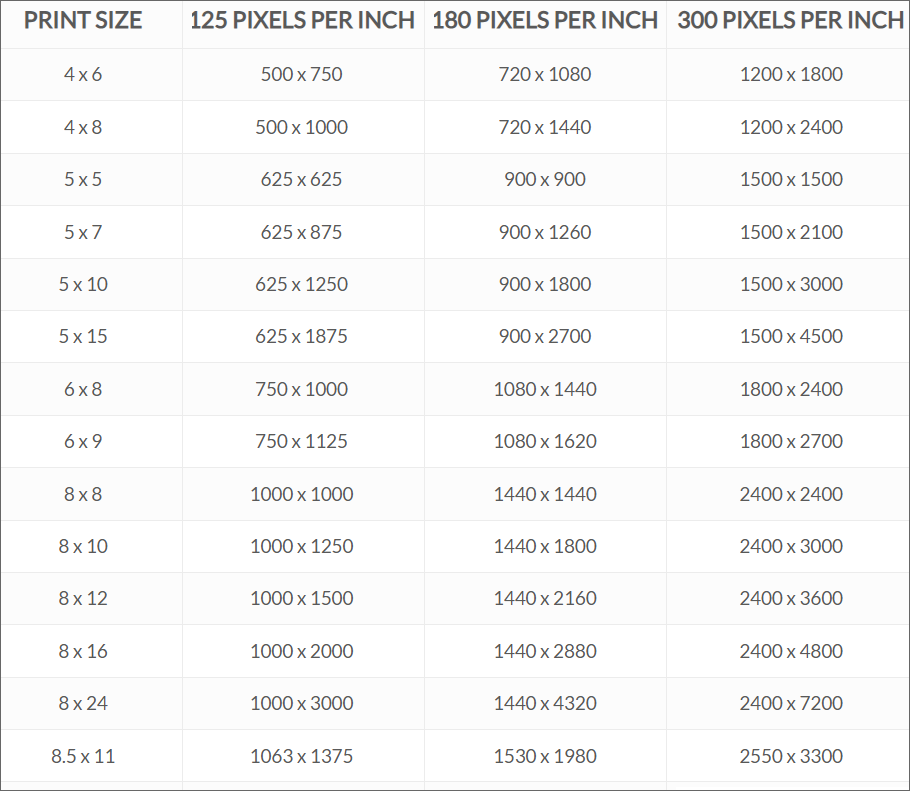
That's a bit of a loaded question – because you also have different quality ranges in printing. You can get/set printers to deliver 125 pixels per inch, 180 pixels per inch ... or for high quality: 300 pixels per inch.
So, let's look at the high quality needs. The camera is set to a landscape orientation at 3:2, the print is at portrait orientation. We will do our calculations at portrait orientation. At 8 inches wide, the ideal number of pixels is 8 x 300 or 2400 pixels. At 10 inches high, the ideal number of pixels is 10 x 300 or 3000 pixels. Do that math, and the perfect number of pixels from the camera is 6,000,000 pixels (6 megapixels).
The marketing messages from the camera manufacturers and vendors is not really a bunch of hooey, though. Take my cameras for example. That would be ideal for a print size of 18 x 27 ... and it means that we can do a significant crop to get to an 8" x 10" photo print. 3.66x crop, to be exact.
A little less obvious is that a single lens can have a really wide range in practical every day use. If we accept that a crop factor can be 3.66x, that means that a 50mm lens can be the equivalent of up to 183mm with the crop – of course, anything in between 50mm and 183mm is also practical.
Makes you shake your head in wonder, doesn't it? As in "wonder" what he's talking about.
Let's clarify. A typical hobbyist lens is 24-70 f/4 zoom. Upgrading to 24-70 f/2.8 can be an expensive proposition ... just for one stop better light gathering capabilities. What I am suggesting is that one single lens, 24mm at f/1.8 or f/1.4 can provide a very good quality photo print at 3.6x crop and that would be equivalent to 24mm x 3.6 or 86.4mm and with outstanding light gathering capabilities.
I understand the reality, though. We don't print photos as much as we used to. Even better, if you are using your photos for posting on the internet, the math works out even better. There's no way we reach anywhere near 8" x 10" on websites ... that would be nearly impossible to view. The highest resolution 4K UHD monitors are 3840 x 2160 resolution. That's equivalent to 8.3 megapixels ... still a crop capability of over 3x. My math holds true even for the highest quality computer monitors.
For reference purposes, I am including a partial screen shot of a fine art print chart (at the top right of this article).
And for those that get the message, the strategy for lenses can change to primes. I've recently added an 85mm f/1.4 lens to my kit. That is now two primes, one 50mm f/1.4 and the new 85mm. I plan on using these a lot more than I ever have (other than my film days where 50mm was the norm).
And, here's a chart using a modest 3x crop ... easily achievable with a 45.7 megapixel sensor camera.
- 24mm ... lens crop range is 24mm to 72mm (equivalent)
- 30mm ... lens crop range is 30mm to 90mm (equivalent)
- 50mm ... lens crop range is 50mm to 150mm (equivalent)
- 85mm ... lens crop range is 85mm to 255mm (equivalent)
- 105mm ... lens crop range is 105mm to 315mm (equivalent)
- 200mm ... lens crop range is 200mm to 600mm (equivalent)
- 400mm ... lens crop range is 400mm to 1200mm (equivalent)
Keep in mind this is an equivalent crop. The equivalence is for the lens, not for the sensor. That means that a prime 50mm lens with f/1.4 remains at that f-stop for the entire crop range through to 150mm.
Makes a solid case for primes that allow a lot of light in, eh?
That's one side, and some consideration. The first consideration is that by using primes to achieve the equivalent of a zoom, you do lose in your ability to use your view finder for framing and composition ... now, you must admit that isn't that critical. After all, if you plan to crop you will end up getting the entirety of the shot in the final image. But it is something you will have to get used to. The second, perhaps even more important aspect, is that if you plan to crop you are accepting that your autofocus area will be magnified by the factor of the crop. If trying to just "nail" the af, you could be missing out by the crop magnification ... meaning your autofocus area is that much smaller to "nail".
Just one final point to make about primes. I'm old school. I've been shooting since 1969 and for at least 35 years, my main lens was a 50mm f/1.8. Long ago, I learned the reason manufacturers included a 50mm lens with film cameras is that 50mm is the closest focal length that matches a human eye. I'm not sure exactly 50mm is right, but that is close. I also got used to the fantastic "bokeh" of a 50mm lens. The "bokeh" of an 85mm lens is even better and creamier.